Dear Dr. Johnson,
Canadian Gender Report is a non-partisan initiative supported by parents, clinicians, and other professionals who share concerns about the medical treatment of children, adolescents and young adults presenting to the healthcare system with transgender or non-binary identities.
The Canadian Paediatric Society (CPS) has a responsibility to ensure that Canadian children and adolescents receive care based on the best available evidence, particularly when the interventions under consideration have significant and potentially lifelong consequences.
Your recent appointment as President of the CPS comes at a time when the medical treatment of gender-distressed young people is being reconsidered internationally. Many countries, including Finland, Sweden, Norway and England, have restricted medicalized pathways and recommended psychological support as the first-line approach. These changes follow substantial efforts to evaluate the evidence and consider the developmental needs of young people.
Meanwhile, the CPS continues to endorse puberty suppression and gender-affirming hormones despite considerable uncertainty about the benefits of these interventions. Multiple systematic reviews of pediatric gender medicine have concluded that the evidence supporting puberty blockers and cross-sex hormones is of very low certainty. In other words, we have very limited confidence that these treatments produce the intended benefits, and their long-term effects remain uncertain.
This raises important questions about the basis for the CPS’s recommendations and whether they adequately reflect the current state of the evidence.
We respectfully ask you to address the following concerns.
1. Very low certainty of evidence for medical treatment of minors
Systematic reviews conducted by methodologists at McMaster University determined that the beneficial effects of puberty blockers and cross-sex hormones are of “very low certainty” across primary patient outcomes examined, including gender dysphoria, depression and global functioning.
Further, a recent registry study of suicide and all-cause mortality in a nationwide Finnish cohort of more than 2,000 young people referred for gender dysphoria, compared with more than 16,000 matched controls, found that once psychiatric history was accounted for, suicide risk was associated with psychiatric history rather than gender dysphoria itself.
The CPS has also previously emphasized the importance of improving the safety and efficacy of medications prescribed to Canadian children.
How does the CPS justify its continued recommendations for medical intervention when systematic reviews find very low-certainty evidence of benefit, and how are these recommendations consistent with its own stated commitment to evidence-based prescribing for children?
2. WPATH has characterized its Standards of Care as Opinions
The World Professional Association for Transgender Health (WPATH) has long presented its Standards of Care (SOC-8) as an important source of clinical guidance, describing them as based on the “best available science and expert professional consensus.”
However, during a recent legal proceeding in the United States, WPATH’s lawyers characterized statements in SOC-8 as “opinions about what conclusions existing scientific research supports.” WPATH also described transgender healthcare as an area of “significant medical debate” and acknowledged that there are differing positions within that debate.
Given WPATH’s characterization of its Standards of Care as opinions reflecting one side of a significant medical debate, what justifies the CPS’s reliance on these standards as a basis for clinical recommendations, especially when other jurisdictions have developed guidance through independent systematic evidence reviews and consideration of developmental factors?
3. The role of parents
You have expressed that parental concerns are not necessarily valid and that parental input is not necessarily required when caring for gender-questioning young people.
Parents often have years of experience observing their child’s development, personality, friendships, behaviour and mental health. In assessing other complex childhood and adolescent conditions, such as autism, ADHD, eating disorders and depression, parental observations and developmental history can provide important context for clinicians.
Why should the assessment of gender-related distress be treated differently from the assessment of other complex developmental and mental-health conditions, where parental observations and input are generally considered valuable in understanding the child’s history and circumstances? What is the clinical or evidentiary basis for this distinction?
4. Other countries have moved toward greater caution
Several countries, including progressive jurisdictions that previously embraced a more affirmative model of pediatric gender medicine, have moved toward greater caution, emphasizing psychological support and psychosocial interventions as the first-line approach.
These changes have followed reviews of the evidence and concerns about the long-term effects of medical interventions during adolescence.
Does the CPS believe that countries such as Sweden, Finland and the UK have reached the wrong conclusions in moving toward more cautious approaches, and, if so, what specific evidence supports the CPS’s continued endorsement of a more medicalized approach?
5. Acknowledging and accounting for detransition
You have spoken about the ability of young people to know who they are and have questioned the need for comprehensive assessment before transition.
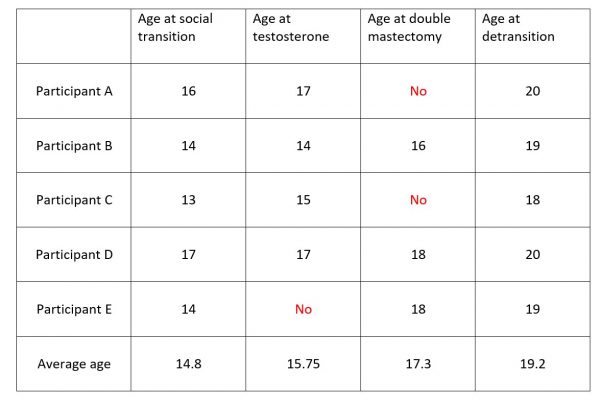
However, detransitioners demonstrate that at least some young people who were once certain of their transgender identity later come to understand themselves differently.
Studies of previously trans-identified young adults who later detransitioned or desisted have found that participants commonly described having initially interpreted mental-health problems or reactions to trauma as gender dysphoria. [2]
How does the CPS account for the experiences of young people who later regret or reverse their social or medical transition, and what safeguards does it consider necessary to identify and protect young people who may eventually desist or detransition?
6. Comprehensive assessment
The CPS position statement refers to comprehensive biopsychosocial assessment, but important questions remain about what such an assessment should involve and what it can reliably establish before an adolescent begins medical transition.
There is also evidence that medical treatment has sometimes been initiated before young people have been assessed by a specialized gender clinic. For example, in 2022, the Gender Pathways Service at London Health Sciences Centre provided referring physicians with information and informed-consent materials for puberty blockers that could be started before a young person’s initial clinic appointment, at the physician’s discretion.
The CPS’s own 2023 position statement supports healthcare providers initiating puberty blockers while young people await specialized gender care.
What specific assessment requirements and safeguards does the CPS consider necessary before a primary-care physician initiates puberty blockers in a minor who has not yet been assessed by a specialized gender service, and how does the CPS ensure that these standards are consistently met across Canada?
We ask these questions because the stakes are extraordinarily high. A child or adolescent experiencing gender-related distress deserves compassion, dignity and appropriate care. But appropriate care must also be supported by credible evidence of benefit. Respect for a young person’s expressed identity does not eliminate the physician’s responsibility to consider alternative explanations, co-occurring conditions, developmental factors and the possibility that the young person’s understanding of themselves may change.
Dr. Johnson, as President of the Canadian Paediatric Society, you are now in a position to help lead this discussion. Psychological and psychosocial support, recommended as first-line treatments in other countries, are not subpar treatments. They provide young people with the opportunity to understand themselves and address underlying difficulties before making decisions with potentially lasting consequences.
We encourage you to lead the way toward a more cautious, evidence-based approach to the care of Canadian children and adolescents experiencing gender distress.
We respectfully ask you to answer these questions publicly and to identify the evidence upon which your answers are based.
Canadian Gender Report
References and Supporting Documents
Research and Published Literature
Ruuska, S.-M., Tuisku, K., Holttinen, T., & Kaltiala, R. (2024). All-cause and suicide mortalities among adolescents and young adults who contacted specialised gender identity services in Finland in 1996–2019: A register study. BMJ Mental Health, 27(1), Article e300940. https://doi.org/10.1136/bmjment-2023-300940
Hepburn, C. M., Gilpin, A., Autmizguine, J., Denburg, A., Dupuis, L. L., Finkelstein, Y., Gruenwoldt, E., Ito, S., Jong, G., Lacaze-Masmonteil, T., Levy, D., Macleod, S., Miller, S. P., Offringa, M., Pinsk, M., Power, B., Rieder, M., & Litalien, C. (2019). Improving paediatric medications: A prescription for Canadian children and youth. Paediatrics & Child Health, 24(5), 333–335. https://doi.org/10.1093/pch/pxz079
Miroshnychenko, A., Ahmed, F. W., Centofanti, J., Floyd, L., Ghadimi, M., Heen, A. F., … & Guyatt, G. H. (2025). Puberty blockers for gender dysphoria in youth: A systematic review and meta-analysis. Archives of Disease in Childhood, 110(1).
Miroshnychenko, A., Ahmed, F. W., Centofanti, J., Floyd, L., Ghadimi, M., Heen, A. F., … & Guyatt, G. H. (2025). Gender affirming hormone therapy for individuals with gender dysphoria aged <26 years: A systematic review and meta-analysis. Archives of Disease in Childhood, 110(1).
Abdul-Kadir R, et al. Gender affirming hormone therapy for individuals with gender dysphoria aged <26 years: a systematic review and meta-analysis. Archives of Disease in Childhood. 2025.
Littman L. Detransition and Desistance Among Previously Trans-Identified Young Adults. Archives of Sexual Behavior. 2023.
MacKinnon, K. R., Morandini, J. S., Pullen Sansfaçon, A., Expósito-Campos, P., Gould, W. A., Rackliff, K., … & Lamba, N. (2025). A latent class analysis of interrupted gender transitions and detransitions in the USA and Canada. Archives of Sexual Behavior, 54(10), 4077–4100. doi.org
MacKinnon, K. R., Rackliff, K., Expósito-Campos, P., Gould, W. A., Morandini, J. S., Pullen Sansfaçon, A., … & Lamba, N. (2026). Gender fluidity and detransition: Results of a cross-sectional study of 957 people in Canada and the United States. International Journal of Transgender Health, 27(4), 1964–1981. doi.org
Vandenbussche, E. (2021). Detransition-related needs and support: A cross-sectional online survey. Journal of Homosexuality, 69(9), 1602–1620.
Other Documents
Canadian Paediatric Society – 2023 position statement on gender-affirming care.
London Health Sciences Centre, Gender Pathways Service – 2022 guidance document to initiate Lupron (puberty blocker) for referring physicians.