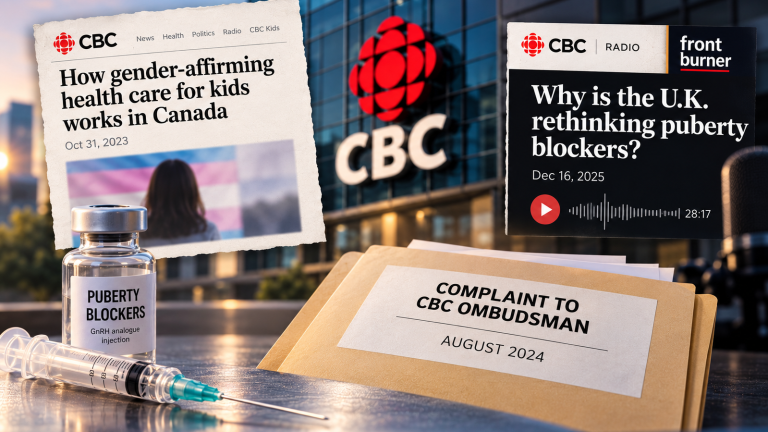
In August 2024, Canadian Gender Report filed a formal complaint with the CBC Ombudsman over the broadcaster’s coverage of puberty blockers for children and adolescents. We didn’t publish that complaint at the time, because we wanted a fair and complete review of the issue by the Ombudsman (yes, perhaps we are naive).
Our concern was straightforward: CBC had repeatedly presented puberty blockers as “reversible” or even “fully reversible” — sometimes as an established medical fact — despite no evidence to substantiate that claim and significant uncertainty about the longer-term effects of suppressing normal puberty.
More than two years later, we are still waiting for the Ombudsman’s response.
We understand that the CBC Ombudsman has a substantial backlog. In the meantime, however, we decided to take another look at CBC’s reporting. What exactly has the public broadcaster been telling Canadians about puberty blockers over the past decade? And has its reporting evolved as the international evidence and debate have evolved?
The results are interesting.
For years, CBC told Canadians puberty blockers were reversible
The word “reversible” appears repeatedly in CBC reporting and explanatory material about medical transition for minors.
Consider just a few examples.
In an October 2023 explainer on gender-affirming care for children, CBC described puberty blockers as “reversible treatments” that pause puberty.
CBC Kids also presented a simple version of the same message to its young audience: if a patient stops taking blockers, puberty resumes. Its coverage described physical changes from puberty suppression as reversible.
Then came a cluster of CBC stories in early 2024.
On February 2, in coverage of Alberta’s proposed restrictions on medical gender transition for minors, CBC reported the Canadian Paediatric Society’s position that hormone suppression is reversible and that puberty continues when treatment stops.
Six days later, a CBC Canada Tonight interview concerning Pierre Poilievre’s comments about puberty blockers featured a physician describing puberty blockers as “fully reversible.”
In March, CBC quoted pediatric endocrinologist Dr. Daniel Metzger saying:
“We know that the puberty blockers are completely reversible.”
And on April 15, 2024 — after publication of the final Cass Review in England — CBC was still reporting that the effects of puberty blockers were “considered reversible” and presenting Canadian clinicians who defended their safety and effectiveness.
That April article is particularly important because the international medical landscape was by then becoming considerably more complicated. At no time did CBC question or attempt to qualify the statements that puberty blockers are reversible.
Then came the Cass Review
The final report of the independent Cass Review was published in England in April 2024 after a multi-year review of gender identity services for children and young people.
The Cass Review brought much greater public attention to questions about the quality of the evidence underlying medical interventions for gender-distressed young people.
CBC covered the report on April 15, but did so primarily through the reactions of Canadian doctors who disagreed with the direction being taken in England. Contemporary analysis of the CBC article noted that it devoted substantial space to Canadian clinicians defending the existing gender-affirming model and criticizing the Cass Review.
But something else was beginning to appear in CBC’s coverage: uncertainty.
In a Front Burner discussion of developments in the U.K. in December of 2025, CBC addressed the meaning of “reversible.” The discussion acknowledged that the term itself was contentious and explored questions about longer-term outcomes.
That is a considerably more useful discussion than simply assuring an audience that puberty blockers are “fully reversible.”
So did CBC change its coverage?
In the CBC material we reviewed, categorical statements describing puberty blockers as “reversible,” “fully reversible” or “completely reversible” appear repeatedly through 2023 and the first part of 2024.
In our review of subsequent CBC coverage, we have not found the same kind of unqualified statement being made by CBC itself. More recent coverage has at times been considerably more cautious about what is known and unknown. This is a welcome development, even while CBC continues to exhibit considerable bias in its coverage of transgender issues.
Recall there were major developments occurring internationally, most notably the Cass Review and subsequent changes in British medical policy. Gender medicine was also becoming an increasingly prominent political issue in Canada.
For example, in December 2025, CBC’s Front Burner devoted an episode to the U.K.’s continuing reassessment of puberty blockers. CBC described the episode this way:
“What we know and don’t know about puberty blockers and children…”
The program specifically examined questions about their benefits, safety and long-term impact.
That doesn’t establish that CBC has changed an editorial position. Nor does it establish why the language is different.
It does, however, illustrate why our original complaint matters.
This isn’t just semantics
Calling a medical treatment “fully reversible” is a powerful reassurance — particularly when the treatment is being considered for children.
A reasonable reader or parent hearing that phrase is unlikely to interpret it narrowly as: puberty will restart if the medication is discontinued.
They are much more likely to understand it to mean: if we stop the treatment, we can go back to where we would have been had we never started it.
Those are very different propositions.
Interestingly, another public broadcaster has already confronted precisely this distinction.
In March 2025, the Australian Broadcasting Corporation’s Ombudsman considered a complaint about a program that had stated that puberty blockers “are reversible.” The program acknowledged that its wording could imply that all effects were reversible and added a correction:
“When the medication is ceased puberty resumes, however some other long-term effects are currently unclear.”
The ABC Ombudsman classified the complaint as partially resolved.
Public broadcasters have a responsibility
CBC is Canada’s publicly funded national broadcaster. Canadians reasonably expect its health reporting — particularly reporting involving medical interventions for minors — to distinguish between established evidence, clinical opinion and areas of genuine scientific uncertainty.
CBC also produces material specifically for children through CBC Kids. That makes precision especially important.
Medical understanding changes. Evidence evolves. Journalists cannot be expected to predict what future research will show.
But where evidence is uncertain, the uncertainty itself is part of the story.
“Puberty resumes after treatment is stopped” is a specific physiological claim.
“Puberty blockers are fully reversible” is a much broader one.
CBC has repeatedly presented Canadians with the latter formulation – and they have yet to issue a correction for the public record.
We asked the CBC Ombudsman in August 2024 to examine whether that reporting met CBC’s own journalistic standards.
More than two years later, we’re still waiting for an answer.
When we receive one, we’ll publish it.
In the meantime, we’ve also published our original complaint so readers can see exactly what we asked CBC to address — and judge the reporting for themselves.